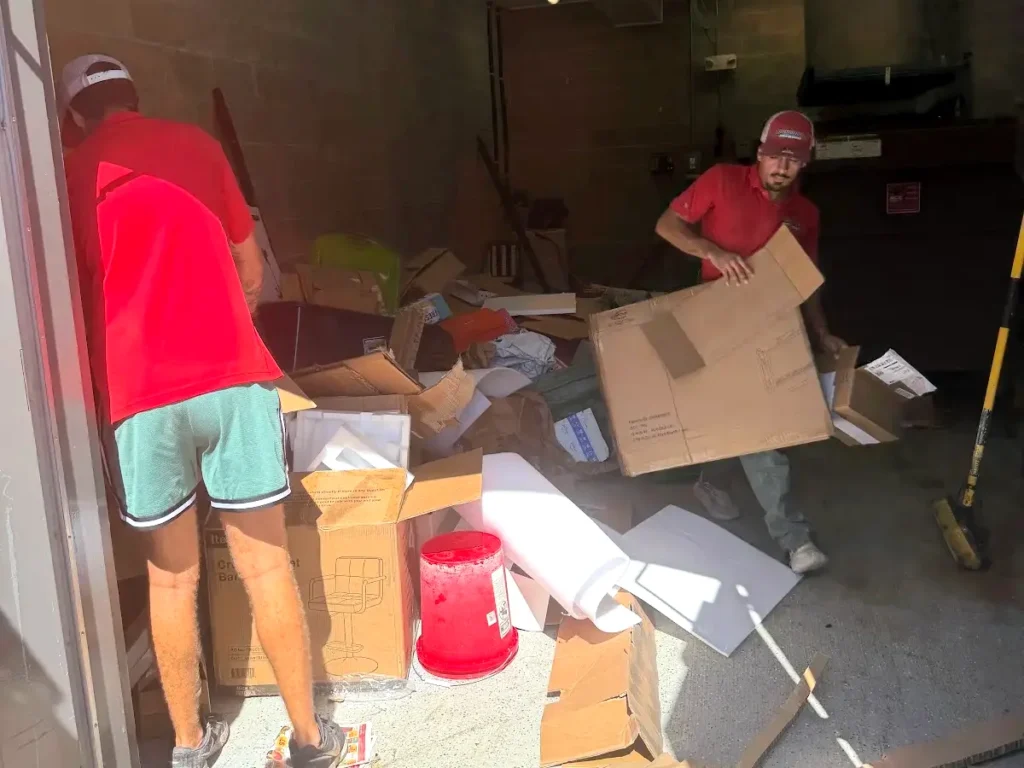
A storage unit cleanout includes a crew and truck, all lifting and loading, sorting for donation and recycling, hauling and disposal, and an empty, broom-swept unit at the end. It does not include deep cleaning, hazardous waste removal or closing out your rental agreement. You approve an upfront price before any work starts, and you don’t need to be at the facility while the crew works.
This guide comes from the Elite Storage Cleanout crew, which clears storage units in McKinney, Allen, Frisco, Plano and Prosper across North Dallas. It covers what the crew handles, what stays your job, the five types of cleanouts, how the job runs and where your belongings end up.
Key Takeaways
- A cleanout covers the crew, truck, lifting, sorting, hauling, disposal and sweep-out. Scrubbing, hazardous waste and facility paperwork are excluded.
- Most storage cleanouts take 1 to 2 hours. Large or packed units take 3 to 4.
- Usable items are donated first and recyclables recycled next. Only the rest goes to disposal.
- Clean Air Act Section 608 requires refrigerant recovery from fridges, freezers and AC units before disposal.
- Booking a few days before rent is due can save a full month of storage rent.
- Elite Storage Cleanout serves McKinney, Allen, Frisco, Plano and Prosper from 7 AM to 11 PM, Monday through Sunday.
What Does a Storage Unit Cleanout Crew Handle?
A cleanout crew handles every physical part of emptying the unit, from the first box at the door to the final sweep. You don’t rent a truck, line up helpers or drive to the landfill.
- Crew, truck and equipment. The crew brings the people, the equipment and the truck, and most units are cleared in one visit.
- Lifting and loading. Sofas, dressers, appliances, boxes and bins all come out without you lifting anything.
- Sorting on the spot. Items that can be donated or recycled are separated while the truck is loaded.
- Hauling. Everything the crew takes leaves with the truck, and nothing is left in the hallway.
- Sweep-out. The floor is broom-swept so the unit is ready to hand back to the facility.
The real payoff is the rent. Once the unit is empty you can give notice, and every month you clear out sooner is a month of rent you keep.
What Isn’t Part of a Storage Unit Cleanout?
Deep cleaning, hazardous waste and the paperwork with your storage facility are not part of a cleanout. The table shows where the line sits.
| Included in a cleanout | Not included |
| Crew, truck and equipment | Scrubbing or sanitizing the unit |
| Lifting, loading and hauling | Hazardous chemicals such as paint, solvents and pesticides |
| Sorting for donation and recycling | Flammable liquids, and propane tanks unless empty |
| Drop-offs and disposal | Asbestos-containing materials |
| An empty, broom-swept unit | Medical or biohazardous waste and certain batteries |
| Giving notice and closing your rental agreement | |
| Choosing what to keep (take those items out first) |
Hazardous items belong in a household hazardous waste (HHW) program. The Texas Commission on Environmental Quality (TCEQ) explains what counts as HHW and where Texans can take it in its household hazardous waste guide. For the facility side, our storage unit cleanout checklist covers what to tell the office and when.
Which Items Will a Storage Cleanout Crew Haul Away?
A storage cleanout crew hauls away almost everything people keep in storage, apart from the hazardous items above. That includes furniture, mattresses, appliances, electronics, tools, boxes, sports gear, yard equipment and leftover building materials.
You don’t need a full unit to book. A single sofa, one fridge or a handful of boxes is a small job, and it gets an upfront quote just like a full cleanout. Items stored in the hallway or just outside the unit door can often go too. Point them out when you book so they’re in the quote.
Not sure about a specific item? Check our full list of items we take or ask before the job.
What Types of Storage Unit Cleanouts Are There?
There are five common types of storage unit cleanouts: full, partial, move-out, inherited and auction or left-behind. The right type depends on what’s inside the unit and why it’s being cleared.
Unit size changes how long the job takes, not how it runs. Elite Storage Cleanout clears everything from 5×5 spaces to 10×30 units, including climate-controlled and outdoor drive-up units.
Full Unit Cleanout
A full cleanout removes everything from the back wall to the door and ends with a swept floor. It’s the quickest way to end a rental, because the unit can go back to the facility as soon as the crew leaves.
Partial Cleanout
A partial cleanout removes only the items you choose and leaves the rest in place. It suits a unit where a few bulky pieces, like an old couch or a fridge, take up most of the space.
Move-Out Cleanout
A move-out cleanout clears whatever is left after you take what you want, so you can close the rental on time. If you’re moving out of town, you can leave on schedule and the crew finishes the job after you’ve gone.
Inherited Unit Cleanout
An inherited unit cleanout clears a loved one’s unit after the family has taken what it wants to keep. Many families work in two rounds: they go through the unit together first, then the crew clears everything that’s left. Our guide on what to do with an inherited storage unit in Texas walks through the first steps.
Auction or Left-Behind Unit Cleanout
An auction or left-behind cleanout clears a unit bought at a lien sale or abandoned by a renter. These units are often packed and unsorted. In Texas, Chapter 59 of the Texas Property Code sets the lien, notice and sale rules facilities must follow before selling or disposing of a unit’s contents. Auction buyers should check their sale terms for the deadline to empty the unit. Our guide to what happens to abandoned storage units in Texas explains the process. This is general information, not legal advice.
Should You Choose a Full or Partial Storage Cleanout?
Choose a full cleanout if you’re ending the rental, and a partial cleanout if you’re keeping the unit or most of what’s in it.
| Question | Full cleanout | Partial cleanout |
| Are you giving up the unit? | Yes, the rental is ending | No, you’re keeping the unit |
| How much is leaving? | Everything | Only the items you list |
| What’s left at the end? | An empty, broom-swept unit | Your remaining items, with the cleared space swept |
Moving to a smaller unit? A partial cleanout first can let you downsize without paying for a second truck.
How Does a Storage Unit Cleanout Work, Step by Step?
A storage unit cleanout runs in six steps, from your first call to an empty, broom-swept unit. Most jobs take 1 to 2 hours once the crew arrives, and large or packed units take 3 to 4 hours.
- Reach out. Call or text (469) 629-7912, or send a request through our contact page. Share the unit size, roughly what’s inside and the facility name.
- Pick a time. The crew works 7 AM to 11 PM, Monday through Sunday, and same-day service is available.
- Approve the upfront price. You see the price and approve it before any work starts.
- The crew clears the unit. Everything is lifted, loaded and sorted, whether or not you’re there.
- Drop-offs. Usable items go to donation, recyclables go to recycling and the rest goes to proper disposal.
- Close-out. The unit is left empty and broom-swept, and the crew lets you know the job is done.
Three things change the job time: how much is inside, how heavy it is and how far the unit is from where the truck can park. When you call, have your unit number, the facility name, your gate code or access details and a short list of anything you’re keeping.
What Should You Decide Before Booking a Storage Cleanout?
Before you book, settle what’s leaving, what you’re keeping, your rent and notice dates, and who has the final say. Most cleanout problems, like an extra month of rent or a lost keepsake, trace back to one of these.
- Full or partial. If some items stay, list or mark them.
- What you’re keeping. Take out photos, papers, keepsakes and valuables before cleanout day.
- Rent and notice dates. Notice rules differ by facility, so read your rental agreement. Booking a few days before rent is due keeps a delay from costing you another month.
- Timeline. Same-day service helps with a tight deadline. If you’re not in a rush, pick a date that fits your move-out plan.
- Who decides. For a family or shared unit, agree on what stays before the crew arrives.
- Hazardous items. Set aside anything on the not-included list for your city’s HHW program.
To budget, see typical price ranges by unit size in our storage unit cleanout cost guide. If you’d rather handle it yourself, follow our steps for how to clean out a storage unit fast.
Where Do Your Belongings Go After a Storage Cleanout?
Belongings from a cleanout are donated first, recycled next, and only what’s left goes to disposal. That order matters. The U.S. Environmental Protection Agency (EPA) reports that 12.1 million tons of furniture and furnishings entered municipal solid waste in 2018, and 80.1 percent of it was landfilled (EPA durable goods data).
| Item | Where it usually goes |
| Furniture in good shape (sofas, dressers, tables) | Donation |
| Clothing, linens and household goods | Donation |
| TVs, computers and other electronics | Electronics recycling |
| Metal shelving, tools and bikes | Metal recycling |
| Fridges, freezers and AC units | Recycling, after the refrigerant is recovered |
| Mattresses and box springs | Recycling when possible, otherwise disposal |
| Broken or damaged furniture | Disposal |
| Paint, chemicals and pesticides | Your city’s HHW program (not taken by the crew) |
Items that are stained, broken or heavily worn usually can’t be donated, so they’re recycled or disposed of instead.
What Happens to Fridges, Freezers and AC Units?
Refrigerant has to be recovered from fridges, freezers and AC units before they’re recycled or thrown away. That’s a federal rule under Section 608 of the Clean Air Act. If you haul an old fridge yourself, check with your city first, since some programs charge a fee.
What Happens to TVs and Computers?
TVs, computers and monitors go to electronics recycling instead of the landfill. Texas law requires TV and computer manufacturers to offer consumer recycling programs, as the TCEQ electronics recycling page explains. If you’re recycling a computer yourself, back up and erase your data first.
Where Can You Drop Items Off Yourself?
Collin County cities run their own HHW and recycling programs for residents, and the rules differ from city to city. Our guide to donating and recycling storage items in Collin County lists local drop-off options.
Where Does Elite Storage Cleanout Clear Storage Units?
Elite Storage Cleanout clears storage units in five Collin County cities: McKinney, Allen, Frisco, Plano and Prosper. See all our service areas, or pick your city:
- McKinney, near Stonebridge Ranch and Craig Ranch: storage cleanouts in McKinney
- Allen, near Twin Creeks and Watters Crossing: storage cleanouts in Allen
- Frisco, near Phillips Creek Ranch and The Star District: storage cleanouts in Frisco
- Plano, near Legacy West and Willow Bend: storage cleanouts in Plano
- Prosper, near Windsong Ranch and Star Trail: storage cleanouts in Prosper
Who Is Elite Storage Cleanout?
Elite Storage Cleanout is a fully insured, local storage unit cleanout team serving Collin County in North Dallas. Pricing is upfront, and same-day service is available.
[Note: Confirm with Jonathan before publishing: years in business and number of storage units cleared. Add one sentence here only if both are confirmed. Otherwise leave this section as is.]
Storage cleanouts often come during a stressful stretch, like a move, a loss or a facility deadline. The crew’s job is to take the physical work and the deadline pressure off your plate.
Get Your Storage Unit Cleared in North Dallas
Tell us your unit size, the facility and roughly what’s inside, and we’ll give you an upfront quote to approve. Call or text (469) 629-7912, 7 AM to 11 PM, Monday through Sunday, or request a free quote.
Frequently Asked Questions
1. Is a storage unit cleanout the same as junk removal?
Not quite. Junk removal usually means picking up a few items from a home or the curb. A storage unit cleanout is planned around the unit itself: the facility’s access hours, the unit size and your move-out date. It ends with a broom-swept unit so you can stop paying rent.
2. Can I book a same-day storage unit cleanout?
Yes. Same-day storage cleanouts are available across McKinney, Allen, Frisco, Plano and Prosper. Calling or texting early in the day improves your chance of a same-day slot.
3. Do heavy items like fridges or tool chests cost more to remove?
Heavy items such as fridges, tool chests, treadmills and sectional sofas take more labor to move. That labor is built into the upfront quote you approve, so it doesn’t appear as an extra charge after the job.
4. Can a crew clear my storage unit if I live out of state?
Yes. You don’t need to be at the facility, so the cleanout can be booked and finished from anywhere. When you book, the crew goes over access, such as your gate code and lock, and lets you know when the unit is empty.
5. What should I ask the storage facility after a cleanout?
Ask the office for written confirmation that the unit is vacant, and check your rental agreement for move-out rules. Giving notice is your step, not the crew’s, so do it once the unit is empty.